Dragon-proof American Foreign Policy Forged in Fire, Burns China
Xi Jinping’s grand schemes suffering severe blows

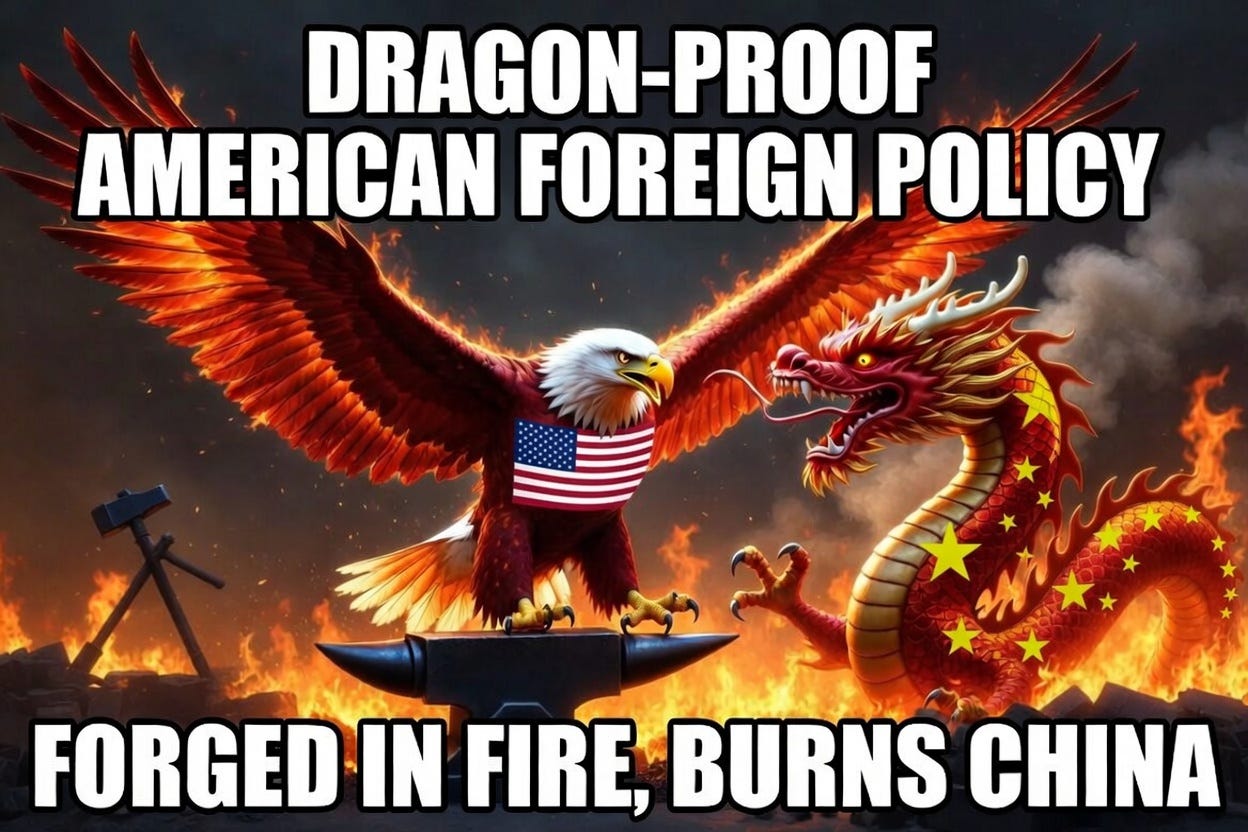
President Trump’s dragon-proof foreign policy systematically targets and reverses Xi Jinping-era Chinese geopolitical and economic gains. It combines economic pressure, targeted regime disruptions, military actions, and hemispheric reassertion to erode China’s influence in key regions, disrupt cheap resource flows, undermine proxy networks, and reassert US dominance. This directly counters Xi’s narrative of inevitable US decline and multipolar “Global South” realignment, and that private meeting between Xi and President Trump in Beijing must have been a doozy!
Let us examine this assertion in detail.
ESTIMATED CHINESE OVERSEAS INVESTMENTS SINCE 2012
Here are China’s overseas investments in three key areas of the world during Xi Jinping’s reign as “supreme leader.” The apparent goal is to create an alternative world economic and geopolitical client-state architecture dominated by communist China.
Africa
Chinese loans to Africa totaled over $180 billion under Xi’s Belt and Road Initiative, exceeding $10 billion from 2012–2018 before plunging post-COVID. BRI engagement surged in 2025 with Africa globally at $61.2 billion in one year, driven by construction in Nigeria, Congo, and other countries), but overall lending trends downward sharply due to debt risks and African borrowing constraints.
Middle East
GCC states have received $128 billion in Chinese FDI, with most coming after the BRI launch in 2013, plus $103 billion in GCC infrastructure contracts. Middle East BRI engagement hit a record $39 billion in 2024 alone, with Saudi Arabia receiving ~$19 billion and Iraq $9 billion. Meanwhile, China’s 2021 25-year Comprehensive Strategic Partnership with Iran promised up to $400 billion in energy, transport, and telecom investments, but actual FDI/investment was only less than $5 billion by 2023.
Latin America
Chinese loans to Latin America companies have exceeded $120 billion, with Venezuela alone accounting for some $60 billion (mostly energy/infrastructure development loans). Chinese FDI to the region reached ~$8.5 billion in 2024, which amounted to 6% of China’s global total. Until the American takedown of the Maduro regime, Venezuela was China’s flagship debtor/client. The Chinese are reeling from the double blow of Venezuela and loss of the Panama Canal contract.
TRUMP’S DRAGON-PROOF FOREIGN POLICY
The top goals of the Trump foreign policy have now been clarified: reprioritization on American interests and security, expansion and refocus on hemispheric influence and security, and confrontation with China. The latter requires an integrated set of policies aimed at “dragon-proofing” to achieve the first two. And this is exactly what we have seen unfold in terms of concrete actions taken over the past year.
President Trump’s multifaceted dragon-proofing offensive – encompassing reciprocal tariffs that accelerate global derisking, targeted regime disruptions in Venezuela and Iran, aggressive hemispheric enforcement under the revived Monroe/Trump Doctrine (“Donroe”), direct military strikes, and intensified anti-cartel operations – has inflicted layered, compounding setbacks on Xi Jinping’s carefully built post-2012 geopolitical architecture in Africa, the Middle East, and Latin America.
These actions did not merely disrupt isolated Chinese bilateral deals; they systematically dismantled cheap-resource pipelines, proxy distraction networks, and narrative scaffolding that Beijing relied upon to project inevitable US decline and cement the multipolar order that has been a main objective of Xi Jinping since 2013.
CHINESE SETBACKS FROM US DRAGON-PROOFING
Reciprocal tariffs and derisking have already slashed new Chinese outbound lending capacity and deterred risk-tolerant capital flows. Africa’s new BRI loans collapsed to roughly $2 billion in recent years and remain anemic into 2026. Beijing has publicly pivoted to smaller, yuan-denominated, and heavily collateralized deals, citing African debt distress but clearly reacting to its own shrinking trade-surplus financing cushion under US pressure. In Latin America and the Middle East alike, promised mega-deals now face heightened scrutiny and capital flight, as global investors recalibrate away from entities entangled with Beijing’s sanctioned partners.
The Venezuela regime change (Maduro’s ouster and capture) delivered one of the most immediate financial and strategic blows. Chinese state firms held claims to over 4 billion barrels of reserves—nearly five times Chevron’s position—through opaque production-sharing agreements, rigs, and debt-for-oil swaps worth tens of billions. Discounted Venezuelan barrels that once flowed at $15 below Brent are now narrowed to ~$5 discounts or outright unavailable. PetroChina and others have halted or refused purchases under the new US-aligned oversight. This severs not only the cheap crude pipeline on which Chinese manufacturing depends but also the illicit-financing circuits that indirectly sustained Iranian and narco-proxy networks.
Parallel US and allied operations against fentanyl precursor transshipment networks (Venezuela–Mexico–Ecuador corridors plus the expanded USSOUTHCOM anti-cartel mission) have compounded these losses by choking Chinese-made chemical flows and associated money-laundering revenue. The Monroe/Donroe Doctrine’s concrete manifestations – that is, Panama Canal concession reversals stripping CK Hutchison of strategic ports, scrutiny of Peru’s Chancay mega-port for potential dual-use military applications, and broader Latin American pushback (Argentina’s Milei realignment, etc.) – have reversed years of quiet Chinese port and infrastructure encroachment in America’s backyard.
The direct US strikes on Iran (Operation Epic Fury) represent the most dramatic reversal. Iran functioned as Beijing’s premier sanctions-busting energy valve: China absorbed ~80–90% of Iranian seaborne exports (roughly 1.6 million barrels per day, or 14% of China’s total seaborne oil imports) at deep discounts via ghost-fleet tankers. Those same strikes destroyed Chinese-supplied radar, surveillance systems (Huawei/ZTE/Hikvision networks modeled on the Great Firewall), and missile components, while exposing the battlefield failure of Chinese-made weapons across Iran, Venezuelan proxies, and Pakistan.
The 2023 Chinese-brokered Iran–Saudi normalization, which was once touted as proof of Beijing’s rising diplomatic heft, has evaporated as GCC states realign even more firmly into the US orbit after indiscriminate Iranian ballistic missile and drone attacks on civilian targets.
Strait of Hormuz disruptions threaten the very sea lanes carrying half of China’s oil imports, while the petrodollar reasserts dominance and the “BRICS petrodollar” alternative is sidelined.
Perhaps most damaging to Xi’s narrative of the inevitability of Chinese ascension to world hegemony is the visual spectacle of US precision power projection that directly contradicts years of CCP information warfare claiming American decline. The swift collapse of Iran’s air defenses and proxy reach frees US naval and air assets previously tied down in the Red Sea and Persian Gulf for potential Pacific contingencies, which is precisely the opposite of Beijing’s desired attrition strategy as it seemingly prepares for a long-hinted cross-channel invasion of Taiwan.
Collectively, these setbacks have eroded China’s military-export credibility, accelerated capital flight from China itself, and forced a humiliating retreat from the “Global South” leadership role it cultivated through discounted resources availability and anti-Western rhetoric. The cumulative effect is not merely economic loss but a structural unraveling of the overextended, debt-fueled client network Xi built to encircle and constrain US primacy.
CONCLUDING THOUGHTS
The effective neutralization of Iran removes Beijing’s most valuable Middle Eastern asset – cheap energy, proxy distraction capabilities, surveillance-model export market, and potential Taiwan-diversion node – leaving only Moscow and Pyongyang as functional allies. A post-regime Iran could pivot westward, repudiate the 25-year pact with China, and expose Chinese surveillance tech and weapons as liabilities.
Venezuela’s parallel collapse severs hemispheric leverage and forces full-market oil pricing. The cumulative loss of client states signals to BRICS and Global South partners that Beijing cannot protect its investments or deliver on anti-Western promises, eroding Xi’s narrative of inexorable Chinese ascent.
Narrative and soft-power collapse is perhaps the most insidious long-term risk for China resulting from sustained US dragon-proofing. Years of CCP information operations claiming US decline, unstoppable BRI momentum, and an emerging multipolar order lie in ruins. Battlefield failure of Chinese systems, swift and overwhelming US power projection, and the petrodollar’s resurgence all reinforce American primacy. Chinese inaction damages credibility among Global South clients who never expected military defense but now see Beijing as an unreliable patron unwilling to risk even rhetorical escalation.
In summary, President Trump’s dragon-proofing strategy, forged in the fires in Iran, has exploited the very overextension and sanctions vulnerability built into Xi’s client-state model, transforming Beijing from geopolitical chess master into a reactive player struggling to protect core energy lifelines and narrative control. The coming weeks will test whether Chinese restraint can salvage enough leverage to prevent a decisive, multi-theater erosion of China’s hard-won influence over the past decade.
President Trump holds all the cards that count and played them in Beijing in his private meeting with Xi Jinping on 15 May. America First, baby!
The end.